The work, one decision at a time
- Took the seat on leadership's own premise. Known: a patented system, factory capacity, one open channel into the builder market. The question was the one leadership asked, how to get more leads through that channel. It produced a working referral relationship and a growing stack of bids. It changed nothing yet, and it did not need to; the bids it produced were the evidence the next step ran on.
- Priced everything the channel sent and looked at it together. Known: a stack of bids across six kinds of work, each priced on its own. The question was whether the quotes held together as a set, because a buyer's estimator compares every bid against a wood-frame budget and against the last number the company gave. They did not hold together. That pointed every later step at the bid desk instead of the marketing calendar.
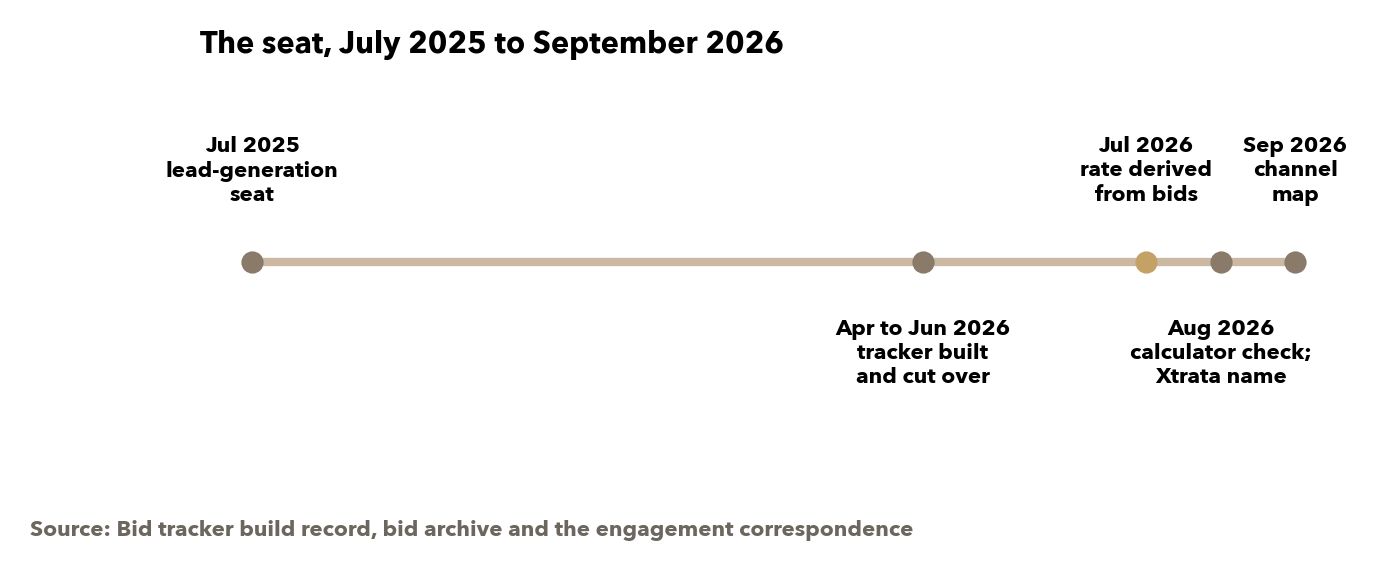
- Built the bid system of record before trusting any pattern. Known: bids living in email and spreadsheets cannot be audited for a pattern. The question was what a bid actually is in this business, and the answer was not a stage and an amount. The same lead can carry two live scopes at once, a SABS base and a wood-frame or metal-building alternate; readiness depends on how far the architectural set has come; and a stalled bid is not distinguishable from a healthy one by stage alone. So I built a purpose-built tracker on Next.js and Supabase rather than configuring a generic CRM: plan-stage bars that follow the documents from concept to issued-for-bid, a readiness pill on every record (firm, preliminary with a stated margin of error, or rough order of magnitude), and a stale-contact badge that fires when a bid goes quiet. It was cut over to its own domain with a read-only share for the manufacturer's team. For the first time the whole book, 32 bids with 13 active at the cut-over, sat in one screen, with the full version history of every bid, roughly 187 PDFs, archived underneath it.
- Ran the numbers across the live set. Known: 14 live bids carried both a labor line and a material line. The question was whether labor tracked material in a stable way across jobs of very different size, because if it did, "every job is different" was false and the company had a formula sitting inside its own history. It did. One honest caveat travels with that finding: whether the labor and material lines were built independently of each other, crew hours against a burdened wage on one side and a takeoff on the other, or whether both were computed off the same square-footage takeoff, is an open question. If they were not independent, the ratio names how the bids were built rather than discovering something new. Either way, the case-by-case pricing story could not survive it.
- Turned the ratio into a bundled install rate and had it checked from outside the building. Known: a ratio is not a price, and an internal regression is not evidence to a skeptical general contractor. The question was who could check the rate without a stake in my number. An outside architect compared it against real crew output on installed work. The rate moved from my private analysis to a figure checked by at least one party who did not work for me or for the manufacturer.
- Took the rate to the manufacturer's own labor calculator. Known: the VP of Operations had built an internal labor calculator of his own, partly so the company would not depend on an outside rate. If his instrument and mine disagreed, the pricing case was dead with the one audience that mattered most. The actual move was to stop defending my own number and hand the decision to the instrument the skeptic already trusted, so he would never have to argue against his own math. He ran live test plans through it against the derived rate. The test was not blind; he knew the target before the plans went in, so what it shows is that his calculator and mine agree on a known target, not that two strangers found the same number independently. Stated exactly that way, the agreement did the job: pricing stopped being my opinion and became something the manufacturer's operations lead could defend without me in the room.
- Reframed the pitch around what the number proved. Known: the old pitch was "specialty product, expect to pay for it," and a premium pitch loses at the bid desk regardless of performance claims, because the buyer is comparing all-in cost per square foot against wood. The question was what the validated rate let us claim. The answer was parity, not premium. Parity removes the objection; it does not by itself give an estimator a reason to prefer panels at the same price, and that reason has to be named separately, in schedule, in fewer trades to sequence, in a firmer date for a dry shell. Writing that second half down, with an estimator's own ranking, is the open piece of the pitch.
- Mapped where the work was actually coming from. Known: with the pipeline in one place, a mail sweep across the archive could ask a question nobody had asked. It found that 11 of the 28 projects in the archive carried the same architect's title block. That is concentration of origin, not a measured conversion rate; bids and wins are not tracked by channel, so it says where the plan sets come from, not who closes better. The mechanism under the count is what matters: on a project that architect designs, the wall assembly is specified at schematic design, before any general contractor is engaged to bid. The buying decision on panels versus framing is made upstream of the point where builder outreach operates at all. My read of the mechanism is that the choice is made at the architect's desk; the architect has not said so.
- Advised against the rename, then carried the work through it. Known: leadership wanted to rename the company from Strata International Group to Xtrata. We advised against it. It was the same company selling the same system, every open bid and builder relationship in the pipeline had been built under the Strata name, and what was costing deals was the number at the bid desk, which a new name does not change. Leadership made the call and went ahead, and it was theirs to make. The question that stayed mine was what to carry across the name and what to retire with it. The pricing doctrine and the narrowed channel plan moved forward intact; the "specialty product, priced case by case" positioning was retired rather than relaunched under the new name.
| Stage of a bid | Before the doctrine | After it |
|---|---|---|
| A lead arrives | One channel contact, priced on arrival whatever the document set | Logged with a plan stage and a readiness state before anyone prices it |
| The bid is priced | Job by job, by feel; a different number depending on who answered | One cost-derived formula; the same number whoever answers |
| The estimator asks why | The bid died here, at the second question | Answered before it is asked: parity with wood, checked outside the building |
| Follow-up | Went quiet in email threads | A stale-contact badge fires in the tracker |
| Award or pass | Untracked; passed and dead looked the same | Won, passed and dead tracked separately, because they need different follow-up |
Table: The bid desk before and after, stage by stage. Source: the bid tracker build record and the pricing work under the seat.
What it produced
The cover carries what the seat put in front of the company: the actual projects bid and the pipeline behind them. The seat also built relationships with 30 developers and general contractors across the country, and there is potential national work beyond them. None of that volume holds if the number on each bid cannot survive an estimator's second question, which is why the cover also carries the check a reader can weigh: the manufacturer's own labor calculator against the derived rate, plan by plan. The spread is not a tight band and I do not present it as one. It is an agreement between two instruments built by two parties with different interests, on a target both knew, and it is what let the company budget SABS labor by a metric it could explain to a buyer.
From that came the sales claim: SABS priced within about 5 percent of conventional wood framing at standard material pricing. That is the sentence the pitch now opens with, and it replaced an unsupported premium narrative. The comparison it rests on, a wood-frame baseline with its date, region and scope written down, is the piece I still want on paper beside it.
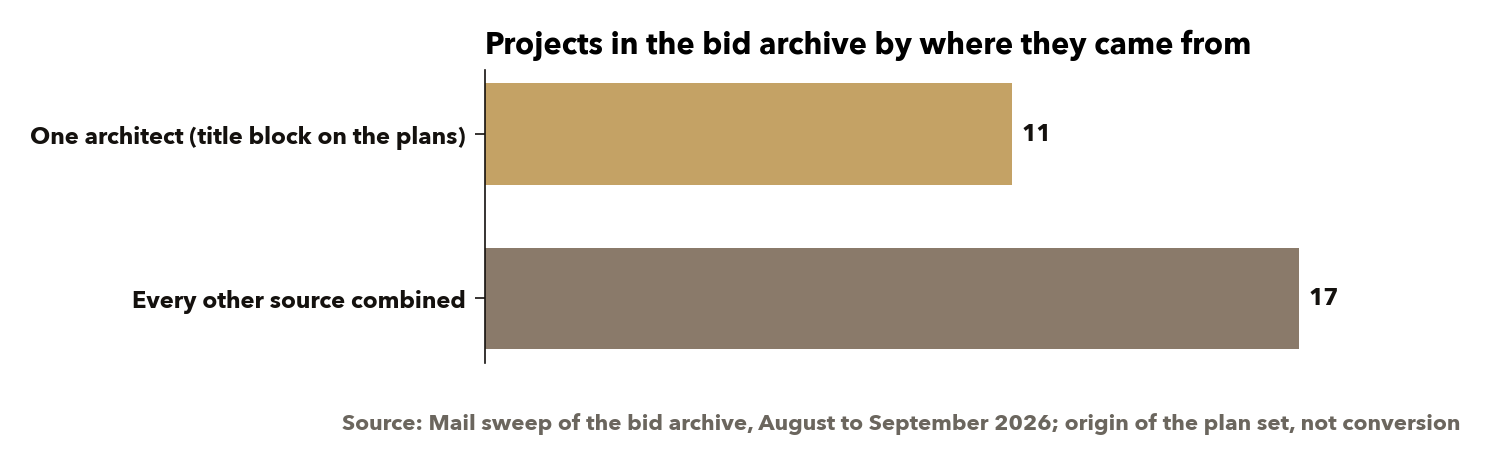
The channel map is the second result, and it changed where the outreach effort goes. Instead of spreading evenly across every general contractor in the market, the plan works the architects and developers whose project mix already favors a panelized shell at schematic design, brings the parity claim into the first conversation so the estimator's confirming question is answered before it is raised, uses the tracker's readiness state to prioritize live accounts whose documents are furthest along, and expands within a converted account before prospecting a new one cold.
The third result is the seat itself. It grew from a lead-referral arrangement into a year-long engagement across marketing, sales, go-to-market strategy, builder and developer relationships, branding, the sales narrative and the pricing plan. That is a buying decision made by the manufacturer's own leadership, not a claim I make about myself, and it is the clearest evidence in this report that the diagnosis held.
Cost-derived pricing for a configured product
Value-based pricing needs a measured willingness to pay across a population of buyers. A manufacturer with a thin bid history selling to estimators who compare all-in cost per square foot against wood cannot measure that, and "value-based" collapses into "whatever this deal will bear," which an estimator cannot check and will not trust. Cost-derived pricing does the opposite: it fixes the relationship between labor and material from the company's own bids, publishes it as the basis of every future bid, and lets the buyer check it. The point is not to capture more value per job. It is to survive the second question.
What we kept, what we retired, what we installed
| Before | After | |
|---|---|---|
| Category claim | A specialty prefab product, priced case by case | A panelized system priced at parity with conventional wood framing |
| Evidence offered to a buyer | Relationship trust in one channel contact | A rate derived from the company's own bids, checked by an outside architect and by the manufacturer's own labor calculator |
| Channel story | Broad builder outreach | Account depth with the architects and developers whose project mix already favors the system |
Table: Positioning before and after. Attachment A carries the full plate and the message architecture.
Kept. The manufacturer's own labor calculator, because an instrument the skeptic built himself is worth more than one I hand him. The bid archive, as the version history every live number points back to.
Retired. Pricing by feel. The manufacturer's sales team had priced each deal on its own, adjusted by judgment, on a premium narrative. Nobody set that up as a policy; it is what a sales culture does with a configured product when there is no bid history to price from. The faulty logic was selling a building system as if it were a product with a brand premium, when the buyer is an estimator who will only ever compare it to wood on cost per square foot. It had to change now because the tracker made the pattern visible for the first time, and leadership was about to spend on lead volume to fix a leak that sat at the bid desk.
Installed. The bid system of record (Attachment B carries its structure). The pricing doctrine, derived from live bids and checked two ways. The parity pitch and the message architecture behind it. The architect-channel plan. And one owned commercial function covering marketing, brand, sales and go-to-market together, so a fix in pricing has to reconcile with the story marketing tells before either ships.
What it cost to hold the line, and what I watch
Holding the line cost standing, more than once. Telling a client its diagnosis is wrong is a withdrawal from the relationship account every time, and the only thing that refills it is the data being right. Running four functions as one seat instead of handing each to a specialist costs depth in any single lane and lengthens the proof cycle. And there is a cost to the manufacturer building its own calculator to be less dependent on my rate: it was the right thing for them to do, and I helped them do it, knowing it made me easier to replace. A doctrine that only works while its author is in the room is not a doctrine.
The seat as it stands: the scope changes month to month, the referral side runs on a commission arrangement, and Common Ground bills the consulting work directly.
What I watch, in order. Win rate and cycle time on bids priced before the doctrine against bids priced after it; the tracker exists to answer exactly that question and it has not been run yet, so the claim that pricing rather than volume was the binding constraint stands on the sequence of events, not on a measurement. Whether the schematic-stage mechanism holds on the next architect account, tested by asking the architect rather than inferring from the count. The wood-frame comparator behind the parity claim, written down with its date and region. And the next calculator check run blind, with the plans entered before anyone sees the derived rate, because a validation of a known target is worth having and an independent one is worth more.
What a competitor could not reproduce is the access the rate was built on. A manufacturer's VP of Operations does not normally hand a consultant his labor calculator to be checked against, and an architect does not normally hand over real crew output. Both happened because the person deriving the rate was bidding the same work, inside the transaction, not advising it from outside.
The result, in short
The seat produced the bid volume and the pipeline the cover carries, priced by a rate the manufacturer's own labor calculator could confirm on its own instrument, which is what let pricing move from an outside consultant's number to something the manufacturer's operations lead could defend without him in the room. The pitch changed from an unsupported premium narrative to a parity claim, checked by an outside architect and by the manufacturer's own calculator. The channel plan moved from broad builder outreach to account depth with the architects and developers whose project mix already favors a panelized shell. The seat itself grew from a lead-referral arrangement into a year-long engagement across marketing, sales, go-to-market strategy, brand and pricing, a buying decision made by the manufacturer's own leadership.
A slice of the project list
A few related projects.
- Canyon Corporate: interior partition package for a Phoenix office-to-residential conversion, priced on Xtrata's wall system (January to September 2026)
- Kanopi: the estimating engine that prices Xtrata bids and every other LIEF job (2026 to present)
- 301 W Osborn: a 1971 concrete office tower in Midtown Phoenix converted to luxury condominiums, principal seat (December 2024 to present)
- The Triangle, Grand Avenue: development lead for a group of Phoenix brokers, capital last (March to June 2026)